

Moving the Earth’s Warmth with Geothermal Heating Pumps

Reading Time:
Geothermal heat pumps move the constant heat present in the earth into your house, business, or local community space. They are more energy-efficient, more environmentally friendly, and cost less in the long run than conventional heating systems.

While it may not always feel like it, especially during our cold Minnesota winters, the ground is always warm. You just have to dig around 100 feet deep to find it. This heat is constant, hovering around 50° F year-round in this region. For generations, people have used this heat to warm their water. Early uses of geothermal energy include Roman baths and hot springs. Today, we harness geothermal energy to heat and cool our buildings.
Geothermal heating allows people to heat and cool spaces in a cost-effective manner. West Central Initiative recently installed geothermal heating in our Fergus Falls headquarters with All Seasons Heating & Air Conditioning out of Ottertail. Stuart Fleischauer, the owner of All Seasons, and his team have been installing geothermal since 1993. Stuart talked with me about the process of a geothermal system and its advantages.
How it Works
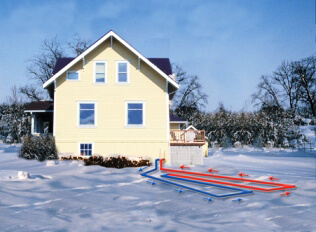
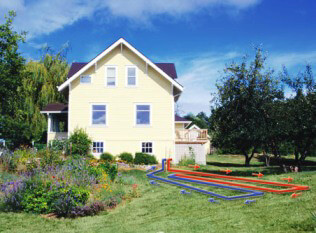
Stuart explained that the system is made up of a loop of pipes buried 100-160 feet in the ground, dug like a well. Our system has 24 wells, and each pipe is encapsulated with grout containing graphite. This bonds the pipes with the earth and helps heat transfer.
The fluid circulating in the pipes is a combination of water and antifreeze. The system is a closed loop, meaning the fluid is continuously used. As it moves through the pipes, heat transfers into the fluid from the rocks, soil, and groundwater. It then transfers up to the building. In the summer months, the process is reversed. Heat is drawn from the surface and dispersed into the ground.
More Efficient
Heat pumps don’t create heat; rather, they move it. This takes less energy and is more efficient than conventional heating and cooling systems. Stuart said that geothermal systems are four times more efficient than conventional friction heaters.
Your hand will become colder much faster when it is wet compared to when it is dry. This same idea applies to the heat transfer in the system. Liquid in the pipes is a much better conductor of heat than air, so a geothermal system is more energy-efficient than an air-source system, which converts heat between indoor and outdoor air.
Earth Friendly

According to the U.S. Department of Energy Office of Energy Efficiency & Renewable Energy, the reduction in energy that comes from geothermal results in a 44% decrease in greenhouse gases compared to air-source heat pumps. When compared to resistance heating systems, which convert electricity to heat, and a standard air-conditioning system, geothermal systems can produce 72% less greenhouse gases.
A Geothermal Future
While the up-front cost of geothermal is higher than average installation of a conventional system, a geothermal system can lower your annual heating and cooling costs by up to 70% according to Otter Tail Power’s website. Along with the lowered utility bill, Stuart talked about other cost saving measures. Electrical companies have rebates on many heat pumps, with Otter Tail Power offering a 30% rebate for residential and 40% for commercial. These rebates include certain specifications which can be found here. There are also federal tax incentives to install heating, cooling, and water heating applications that are highly energy efficient thanks to the Inflation Reduction Act.
Geothermal is one of the most energy-efficient ways we can heat and cool our houses, businesses, schools, churches, nonprofits, or any other buildings. If you are looking for a utility cost-saving measure and a greener alternative, consider geothermal.
About Brogan Ludwig