
Should I Buy an Electric Vehicle? Rural EV Drivers Share Their Experiences

Reading Time:
Thinking about buying an electric vehicle (EV)? With increasing gas prices and concern about climate impacts, more people are curious about going electric than ever before. But finding reliable info isn’t always easy. Especially in rural Minnesota, where concerns about cold weather and a lack of charging options dominate the conversation, car buyers are often skeptical about purchasing EVs. In 2024, EVs made up 9% of new car sales, while electrified vehicles (hybrids, plug-in hybrid electric vehicles (PHEVs), and EVs) accounted for 22%—and the numbers keep growing as more car owners make the switch. In our first Sustainable Communities Network meeting of 2025, we approached this topic head-on with a panel of five rural EV owners and regional clean energy expert Heidi Auel.
EVs are Clean, Efficient, and More Accessible Than Ever
Heidi Auel, the Central Minnesota Clean Energy Resource Teams (CERTs) Coordinator often shares information about EVs as a part of her role. One of the clear benefits of owning an EV is that it’s much cleaner than other forms of transportation. Auel says, “Cars that run on electricity pollute much less than gasoline cars. In Minnesota, EVs release 58% less emissions than their gasoline-fueled counterparts.” This means cleaner air around your home, neighborhood, and community.
Electric motors are also more efficient than traditional internal combustion engines. Traditional combustion engines lose roughly 60% of the energy they consume in the form of heat. However, electric motors use almost all of the energy they consume to power the vehicle making them more efficient and cost-effective than fueling up at a gas station.
Auel shared that the range of EVs is increasing, as well as affordability – “The average range for battery electric vehicles is about 275 miles. About one third of the EVs are priced under $50,000, so roughly equivalent to some of the regular gas models right now.” Auel also covered the incentives that are available. At the Federal level, there is a $7,500 tax credit for a new EV or PHEV and a $4,000 tax credit for a used EV or PHEV. There are also local utility incentives; for example, Otter Tail Power offers a $3,000 rebate for new EVs and a $1,500 rebate for new PHEVs for Otter Tail Power customers.
Real EV Owners Share Their Experiences
Panel members shared some of the highs and lows of EV ownership, but mostly the highs. Chuck Adelsman from Dalton, Minnesota, shared how his Kia EV6 can act as a mobile generator, powering homes and other devices during outages. Chuck added “In July, when air conditioners are running full blast, you—along with thousands of other EV owners—can send a little electricity back to the grid from your car’s battery. You won’t even notice the difference, but it helps utilities avoid the need for a whole new power plant.”
Chris Happel from Perham, Minnesota, owns two EVs, a Tesla Model 3 sedan and a Rivian R1T truck. He had a lot of technical information to share, owning two EVs with two very different use cases. “I’ve always had stick shifts like a Subaru WRX or a 5-speed Mustang, and I thought I’d really miss the feel of driving the car,” said Chris. “A stick shift helps control torque in gas cars, but EVs deliver full torque instantly—just press the pedal carefully, or you might get whiplash.”
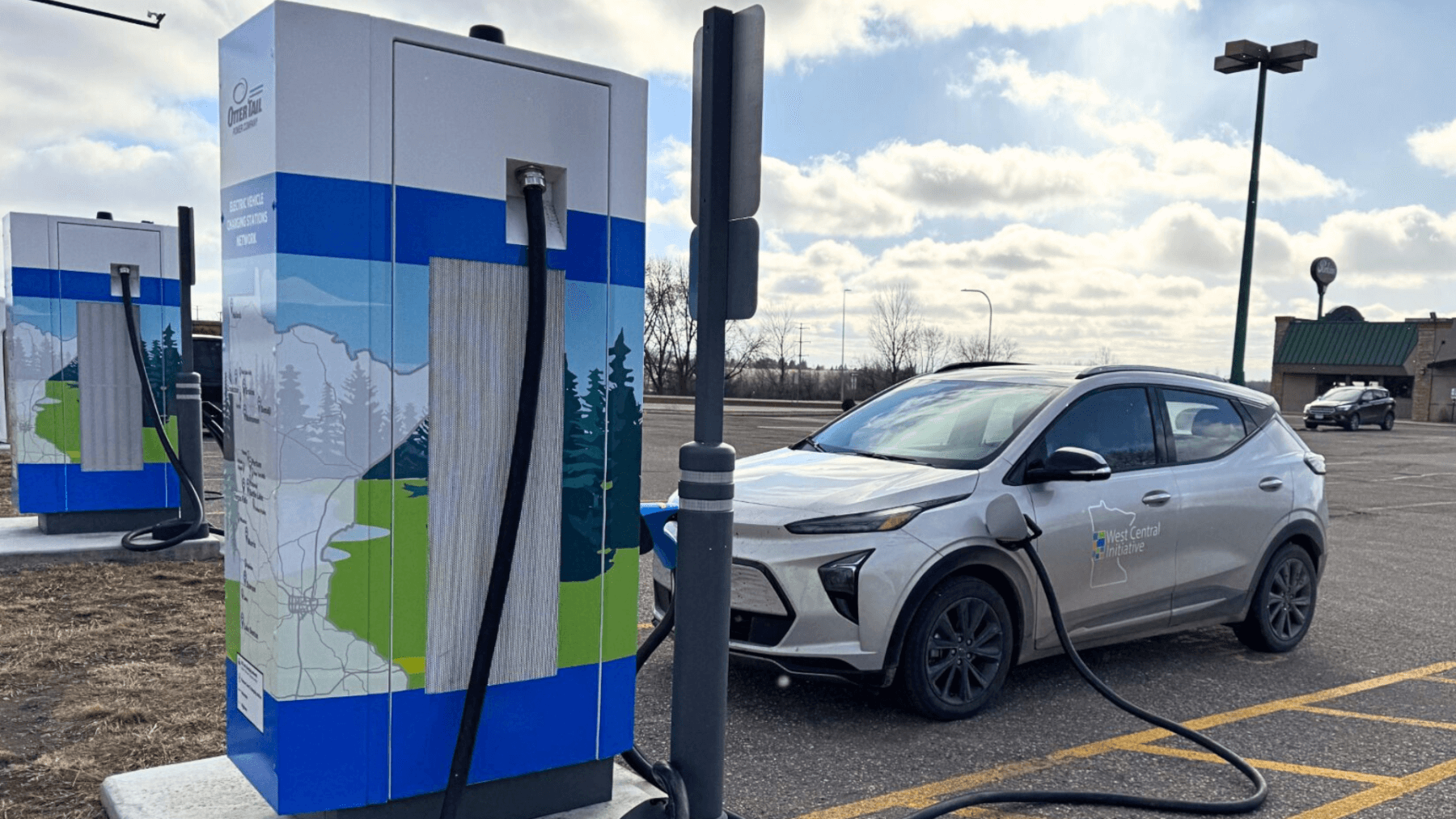
Molly Stoddard from Fergus Falls, Minnesota owns a Chevrolet Bolt electric utility vehicle (EUV). She emphasized the day-to-day experience of owning an EV. “It helps me reach my own personal goals to live a more sustainable lifestyle,” said Molly. For her, most of her daily driving is around Fergus Falls. Although the Bolt EUV doesn’t compete with other EVs in terms of range and charging speed, it was a perfect match for Molly’s driving. She charges the vehicle overnight in her garage on a 120-volt (slow) outlet. “When I looked at my monthly electric bill, it was only about ten bucks more a month,” said Molly. “I just replaced my tires, and it cost over a thousand dollars because EVs need strong, high-quality tires to support their heavy battery.”
How do EVs Fit into Rural Households?
According to the American Community Survey, 30% of households in our region own three or more vehicles, often including a heavy-duty hauler for towing, a family car for long trips, and a daily driver for errands and commuting. By replacing the daily driver vehicle with an EV, drivers can save on local transportation costs by using an EV for shorter daily trips or commuting.
EVs also make great starter cars for new drivers. A 2018 Nissan Leaf, for example, offers up to 130 miles of range, low maintenance, and affordable driving—especially in rural areas. With charging incentives from utilities like Otter Tail Power, a full recharge can cost as little as $0.44, meaning driving 50,000 miles in a year could cost just $160 in fuel.
With rising gas prices, exciting features like instant torque, and lower maintenance costs, EVs are becoming a practical choice in west central Minnesota. As new models hit the market, including those with gas range extenders, EVs are proving to be a viable option for rural drivers now and in the future.
About Griffin Peck