Climate & Energy
Getting Started with Solar
We’re seeking ways to encourage solar energy development in our region.
This webpage represents a collection of solar information and resources for the region. Our solar goals and associated strategies and actions can be found in the Region 4 Climate Action Plan. For more information about the basics of solar energy, your solar options, and questions to ask solar professionals, read the Residential Consumer Guide to Solar Power and visit the Department of Energy’s Homeowner’s Guide to Going Solar.
West Central Initiative is working to become a SolSmart-designated Regional Organization by implementing best practices to make it easier for residents and businesses to install and access solar energy. SolSmart is a national program funded by the U.S. Department of Energy that has helped hundreds of local governments become “open for solar business.” Learn more about the program here.
The Benefits of Going Solar
Solar energy uses a renewable energy source – the sun – and provides many benefits for individuals and the region. It improves environmental quality by reducing carbon emissions and air pollution, supports local solar companies in Minnesota, creates local jobs, saves money on energy costs, and improves electric grid resilience during peak demand and other stresses to the system.
Connect with Us

Cedar Walters
Director of Climate and Sustainability Programs

Griffin Peck
Energy and Adaptation Planner
Solar Energy in West Central Minnesota
The Region 4 Climate Action Plan sets a goal of 22% region-wide renewable energy generation by 2030, with current renewable energy generation at 6%. There are several solar energy projects in the region, with more currently under development that will move the region toward our renewable energy goals.
Morris Model
The City of Morris has multiple solar projects, including installations on the municipal liquor store, library, and City Hall, for a total of 150 kilowatts (kW) of installed solar. Learn more about the Morris Model.
Hoot Lake Solar- Fergus Falls
Hoot Lake Solar is a 49-megawatt (MW) solar generation facility owned and operated by Otter Tail Power, located in Fergus Falls, Minnesota. The site generates enough energy to power approximately 9,000 homes each year. Learn more about Hoot Lake Solar.
Lake Region Electric Cooperative- Pelican Rapids
Lake Region Electric Cooperative owns and maintains a 24.6 kilowatt (kW) community solar installation in Pelican Rapids.
West Central Initiative Supported Projects
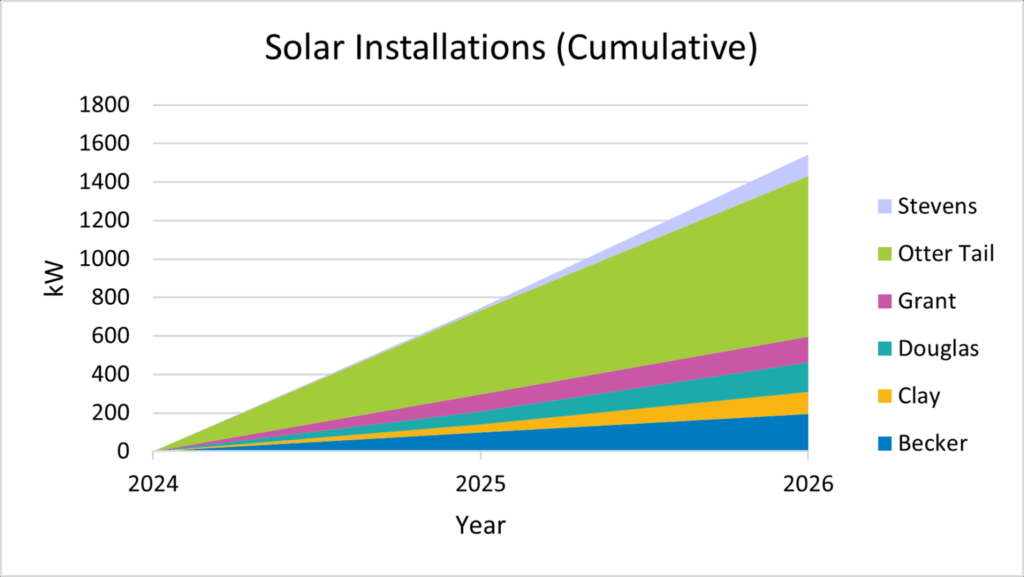
In 2024, West Central Initiative began building regional capacity to support distributed solar development across west central Minnesota. Through our Municipal Solar Cohort, we supported 10 small-scale solar projects in 2025 by providing technical assistance and connecting communities to financial resources and incentives. We expect to support an additional 13 community solar projects in 2026. Together, these municipal projects totaled nearly 450 kW of installed solar in 2025, with another 600 kW projected next year.
We also partnered with Solar United Neighbors in 2025 to lead a regional Solarize campaign, which resulted in 20 completed residential solar projects. A second campaign is planned for 2026 and is expected to support an additional 10–15 projects, further expanding access to solar energy for households across the region.
Steps You Can Take to Start with Solar
Solar Mapping and Production Value Projections
- MN Solar Suitability: Ground and Roof Analysis App
- Google Project Sunroof: Rooftop Solar Suitability App for individual buildings, cities, and counties
- National Renewable Energy Lab’s photovoltaic (PV) Watts Calculator: Ground and Roof Analysis App
- Midwest Renewable Energy Association’s Solar Project Builder: Analyze potential benefits of finance options
Finding a Contractor and Going Solar
- Find a solar contractor(s) to assess your home or business for solar energy and provide a quote.
- Solar Owner’s Manual – information for current solar homeowners to ensure they are getting the most out of their system from Solar United Neighbors.
- Certified practitioners can be found through the North American Board of Certified Energy Practitioners (NABCEP).
- Visit EnergySage to learn about solar energy and submit for solar quotes from a network of pre-screened, local solar installers
- Solar Customer Resource Portal – various resources from the Solar Energy Industries Association (SEIA).
Financing, Incentives, and Tax Exemptions
Typically, solar installations are paid for through loans, upfront payments, or a power purchase agreement (PPA). Federal and State incentives are available to help make solar an affordable option.
- A Homeowner’s Guide to Solar Financing – learn about different financing options from the Clean Energy States Alliance (CESA).
- Homeowner’s Guide to the Federal Tax Credit for Solar Photovoltaics – learn about the federal tax credit, eligibility, and other common questions & answers from the U.S. Department of Energy.
Federal Incentives
There are many new incentives and funding opportunities available for solar and other clean energy technologies.
- A great place for residents to start identifying the federal incentives for which they are eligible is this calculator from Rewiring America. The rebates and incentives available through the federal Inflation Reduction Act can vary depending on your location and income.
- Additional details about benefits in the Inflation Reduction Act can be found on the White House’s website or the Department of Energy website.
- The Federal Investment Tax Credit for residential solar continues to be one of the most significant ways to reduce the cost of your solar photovoltaic (PV) system. Learn more about the federal tax credit, eligibility, and other common questions & answers in the Homeowner’s Guide to the Federal Tax Credit for Solar Photovoltaics from the U.S. Department of Energy.
- Businesses should refer to the Federal Solar Tax Credits for Businesses.
- Some solar projects will be eligible for bonus credits on top of the 30% Investment Tax Credit. The Inflation Reduction Act provides up to 20% in bonus credits for qualified solar or wind facilities developed in low-income communities; up to 10% bonus for projects located in “energy communities” that have a historic fossil-fuel economy, high unemployment, or are developing solar on a brownfield; and 10% domestic content bonus for projects using the required amounts of U.S.-produced steel, iron, and manufactured products.
- The World Resources Institute has created an Individual Retirement Account IRA Bonus Mapper tool to help identify communities that are eligible for the low-income and energy community bonus credits.
- Tax-exempt organizations, including non-profit organizations, schools, and government entities, can now take advantage of the federal tax credit through “elective pay” (sometimes referred to as “direct pay.”) An overview of elective pay and Frequently Asked Questions are available from the Internal Revenue Service (IRS).
State and Local Incentives
Publicly Owned Property (POP) Solar – Otter Tail Power Publicly Owned Buildings Solar Rebate Program offers a rebate of $1500 per kW on installed solar up to 40 kW on municipal buildings.
Solar on Public Buildings – Grants for Xcel Energy customers for up to 70% of the project costs (dependent on the government’s financial capacity) for a solar array that is built on or adjacent to a public building and is the lesser of 40kW system capacity or 120% of the building’s annual energy consumption.
Planning & Inspection Resources
- American Planning Association
- SolSmart Resources including webinar trainings
- MN Department of Labor and Industry: Solar Photovoltaic (PV) Checklist
- MN Department of Labor and Industry: Solar Photovoltaic (PV) Resources
- Interstate Renewable Energy Center: Model Inspection Checklist for Rooftop Photovoltaic (PV) Systems
Consumer Protections, Solar Rights, and Procedures
Find other useful resources on solar rights, consumer protection, and procedures.
- Consumer Solar Checklist – a checklist for residential consumers considering solar energy from the Interstate Renewable Energy Council (IREC).
- Solar United Neighbors’ Solar Owner’s Manual – serves as a support for solar homeowners whether you’ve just gone solar or you’ve had solar for years.
- Clean Energy Consumer Bill of Rights – ensure a positive consumer experience by addressing important issues from the Interstate Renewable Energy Council (IREC).
- Database of State Incentives for Renewables and Efficiency (DSIRE) – provide state-specific information on incentives and policies that support renewable energy and energy efficiency in the United States.
- A Beautiful Day in the Neighborhood: Encouraging Solar Development through Community Association Policies and Processes – includes details on how communities can encourage solar development through community association policies and processes.
SolSmart Gold
West Central Initiative was awarded the SolSmart Gold designation in recognition of our efforts to support solar energy development across the region. This designation highlights our commitment to advancing renewable energy by increasing access to solar funding and financing, assisting local governments in developing solar projects for municipal buildings, and supporting a regional solar co-op campaign in partnership with Solar United Neighbors.
We have also provided training for local governments on permitting, inspection, and planning processes related to solar energy. By investing in small-scale solar, we aim to promote energy independence, generate power where it is used, and help keep long-term energy costs low for our communities.
Connect with Us
Cedar Walters
Director of Climate and Sustainability Programs
Griffin Peck
Energy and Adaptation Planner